
CPU Museum › Intel gallery › view in gallery
P4 · Intel
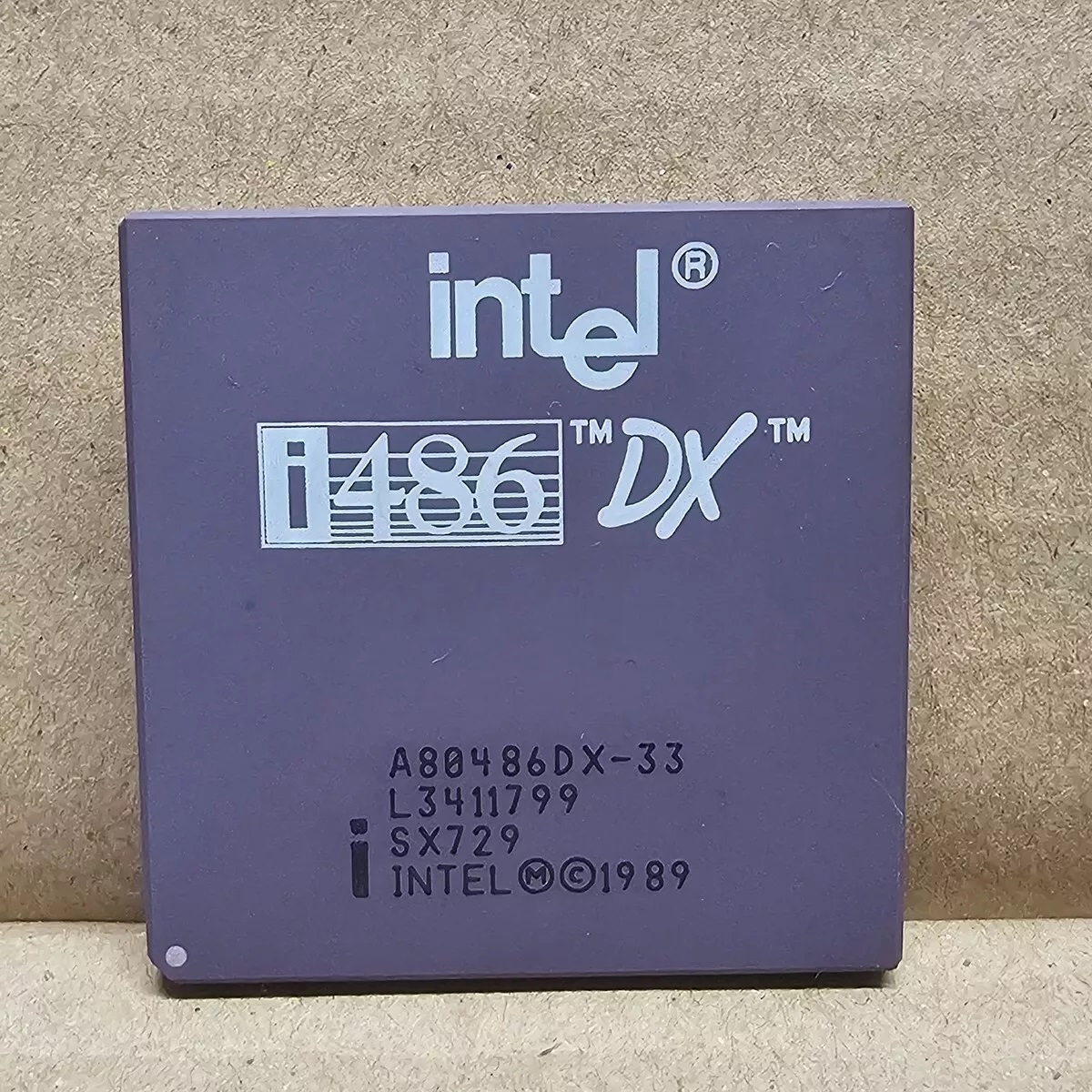
4th gen Intel architecture.
a 32-bit processor introduced in 1989.
This processor contains a new x87 FPU + L1 cache. And a 33 MHz bus.
This chip, while high-end at the time, used on desktop PCs,
it could be passively cooled.
it used 5 volts (vs modern CPUs of ~0.7-1.0 V).
486 was about 2x (twice) as fast as a 386 at the same clock rate !
So a 486DX2-66 was about ~8x times (!) faster than a 386DX-16 chip in most 16-bit and 32-bit applications.
2x due to IPC; instructions per clock efficiency gains of 486 architecture.
multiplied by 4x due to higher clock-rate. All that in a space of only several years !
Mind-boggling progress at the time in the 1980's and the 1990's. The Golden Era of Compute.
486SX - a variant without a floating-point unit (FPU), which had to be purchased separately.
486DX-33 MHz - multiplier x1; released in 1989.
486DX2-66 MHz - multiplier x2; released in 1992. (most common)
486DX4-100 MHz - multiplier x3 (not x4 !); released in 1994 + 16K L1 cache. 1.6m transistors.
There were also a variants with 20 MHz/40/50 and 75 MHz. Less common.
1 result(s) recorded for this family.
Flagship: Intel 486DX2-66 MHz
ST score/GHz: 36.2 · MT score/Watt: 0.34
| Specification | Value |
|---|---|
| Introduced | 1989 |
| Arch Generation | 4 |
| Core Generation | pre-historic. |
| Architecture / Codename | P4 |
| Cores / Threads | 1/1 |
| Technology Node | 800 nm (600 nm for some models) |
| Die Size | ~90 mm² |
| Transistors | 1.25 million |
| Frequency | 33-100 MHz |
| Instructions | 8 KB (shared for i+d) |
| TDP | ~10 Watts est. |
| Cache L2 | up to 512 KB (on mainboard) |
| Memory Type | EDO-DRAM (most common) |
| Memory Bandwidth | |
| Memory Size Typical | 8-16 MB |
| Memory Size Max | theoretical. max = 4 GB; practical max = 64 MB |
| Note | After Intel, other vendors, including AMD, Cyrix, GreenCPU, IBM and ST copied this design, and released their own compatible versions. They had very similar architecture and performance, and were socket compatible with Intel systems. |