
CPU Museum › Intel gallery › view in gallery
i386 · Intel
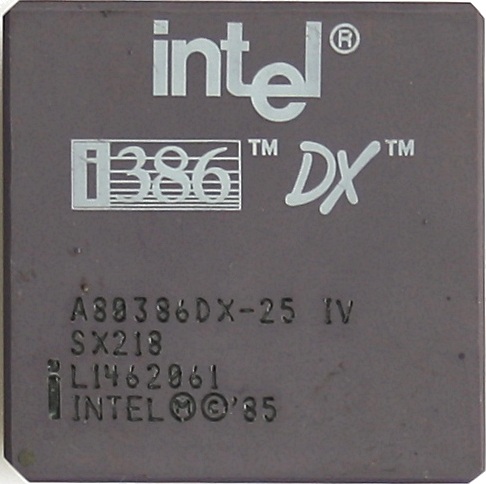
3rd gen Intel architecture.
It was a ground-breaking revolution at the time;
It both allowed 32-bit programs to run, but was also much faster than the previous-gen 286 chips at executing 16-bit (DOS) programs.
The first Intel 32-bit processor introduced in 1985.
optional separate 387 chip for FPU / floating point unit had to be purchased separately both for SX and DX series.
optional cache chip on the mainboard had to be purchased separately.
The VGA cards on those systems also had very little memory, which limited the 2D resolution
to a very low value like 640x480 or even 320x240 on some PCs, at 256-colors.
Bus was running at CPU speed, so 16-33 MHz typical.
| Specification | Value |
|---|---|
| Introduced | 1985 |
| Arch Generation | 3 |
| Core Generation | pre-historic. |
| Architecture / Codename | i386 |
| Cores / Threads | 1/1 |
| Technology Node | 1500 nm |
| Die Size | 104 mm² |
| Transistors | 275,000 |
| Frequency | 12.5-33 MHz; 16 MHz and 20 MHz were common. |
| Instructions | x86. 32-bit. |
| TDP | ~8 Watts est. |
| Cache L1 | none |
| Cache L2 | none (8 KB optional on mainboard; called "external cache") |
| Memory Type | FPM-DRAM / EDO-DRAM |
| Memory Bandwidth | |
| Memory Size Typical | 2-8 MB (and around 256K-512K video memory; limiting VGA resolution) |
| Memory Size Max | |
| Data Width 386Dx 32 Bits (386Sx | 16 bits) |
| Address Width 386Dx 32 Bits (386Sx | 24 bits) |