
CPU Museum › Intel gallery › view in gallery
NetBust / Willamette · Intel
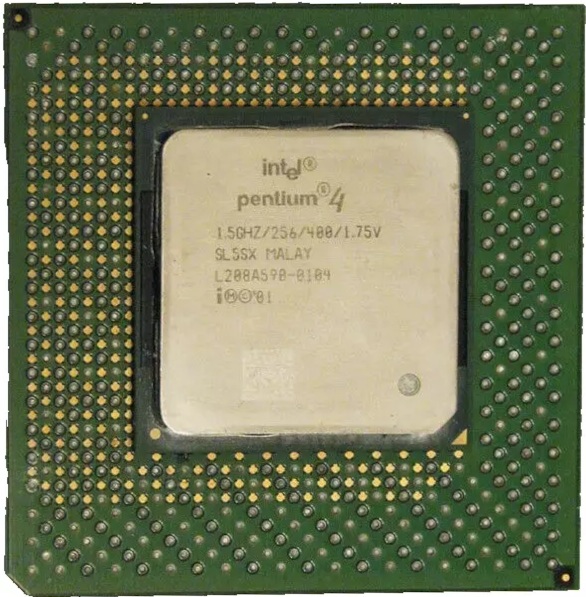
Pentium 4 is the next-gen of Intel Architecture.
In an attempt to increase clock-speeds even faster, Intel has designed a new CPU architecture
from the ground-up, with very long pipeline.
It performed well in some workloads including multimedia / video encoding and de-coding, but
it did poorly with unpredictable code patterns, especially emulation, even slower than the older Pentium III and AMD Athlon in many workloads.
Because of the long pipeline, Instructions per cycle (IPC), was the lowest in the industry, much under-performing vs.
both the Pentium III and the Pentium 4.
Longer pipelines allows to increase the clock speed, at the cost of power consumption, branch mispredicts and data cache misses, resulting in lower IPC.
Intel hoped it would reach up to 10 GHz and above, but it never did.
It was a very power hungry design, unstable to scale, and it did very poorly in laptop-designs.
Eventually after reaching over 3 GHz, intel realized that the architecture is simply inefficient,
they abandoned it and replaced it with a Core 2 Duo architecture, based on the Pentium III, not the Pentium 4 !
Initially it required a very pricey and expensive RDRAM memory, limiting user's appeal, but later
it migrated to SDRAM and DDR memory standards.
| Specification | Value |
|---|---|
| Introduced | 2000 |
| Arch Generation | 7 |
| Core Generation | pre-historic. |
| Architecture / Codename | NetBust / Willamette |
| Cores / Threads | 1/1 |
| Technology Node | 180 nm |
| Die Size | 217 mm^2 |
| Transistors | 42 million |
| Frequency | 1300-2000 MHz |
| Instructions | 8 KB / 8 KB (8 KB for micro-instructions t-cache) |
| TDP | ~35-110 Watts |
| Socket | Socket 423 |
| Cache L2 | 256 KB |
| Memory Type | SDRAM/DDR1/DDR2/RDRAM |
| Memory Bandwidth | varied. |
| Memory Size Max | 4 GB (64 GB with PAE mode) |
| Memory Size Typical | 64-128 MB; mainly because early models with RDRAM were crazy expensive. |